
3-day northern lights forecast
The next three nights for your city, using NOAA's Kp forecast, cloud cover and darkness.
Loading forecast...
Fetching NOAA's Kp forecast and your local cloud cover…
72-hour Kp forecast
Bars are the forecast Kp for each 3-hour block. Green bars reach the Kp needed for aurora overhead and yellow bars for aurora low on the horizon. The strip on top shows cloud cover, with brighter meaning cloudier. A lighter background means daylight.
NOAA aurora map
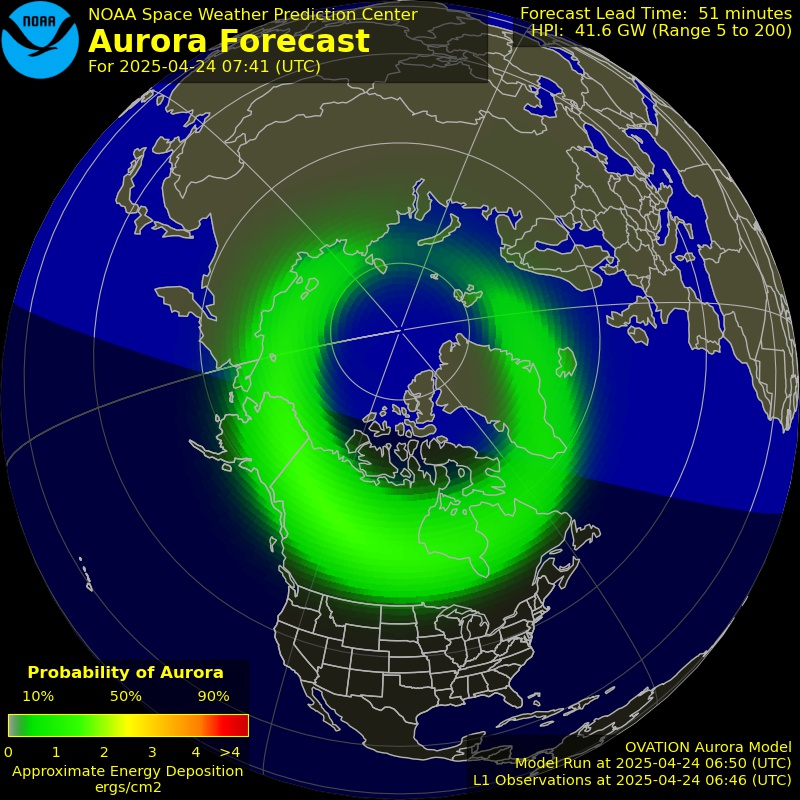
Kp forecast: NOAA SWPC. Beyond the first day the forecast is much less certain, because a CME can arrive early, late or not at all. Cloud cover: Open-Meteo, with OpenWeatherMap as backup. City search: OpenStreetMap.
How to read the 3-day northern lights forecast
The forecast above shows the next three nights for your city: a verdict for each night, the best window, and a 72-hour chart of NOAA's Kp prediction. This guide explains what those numbers mean and, just as important, how far to trust each day.
Treat tonight's forecast as the most reliable, tomorrow night's as good enough for planning, and the third night as a rough guide. None is a guarantee: a coronal mass ejection (CME) that arrives early, late or not at all can change days two and three completely.
- How far to trust it
- Reading the forecast
- What Kp can't tell you
- The storm scale
- Why it changes
- A 3-day plan
How far ahead can you trust an aurora forecast?
Aurora forecasting is closer to a storm forecast than a weather forecast, and its accuracy drops quickly with distance. Here is what to expect at each range.
About an hour ahead: the most reliable warning
Satellites about 1.5 million kilometres sunward of Earth measure the solar wind before it reaches us, which typically gives about 15 to 60 minutes of notice depending on the wind's speed. That warns you about conditions arriving soon, not how strong the aurora will get. A key reading is Bz, the north-south direction of the wind's magnetic field, and it cannot be known for a CME until the CME passes those satellites.
Tonight: the best-informed forecast
Within about a day, forecasters can see which CMEs and fast streams are on their way. That makes tonight's Kp forecast the best-informed of the three. It can still be wrong by a Kp step or more, especially when it depends on a CME arriving, and even a correct Kp does not guarantee a visible aurora from your city.
Tomorrow night: good for planning
Two days of lead time is enough to decide whether to book time off, find a dark site or check the cloud outlook. Expect the timing to move. CME arrival-time predictions can be wrong by many hours: published evaluations have found average errors of roughly 10 hours or more, with individual events varying widely. Treat the estimated arrival as a window, not an appointment.
The third night and beyond: a rough guide
By day three the forecast mostly reflects what is already known, such as a CME in transit or a coronal hole turning toward Earth. That is why the widget marks nights two and three as lower confidence, an editorial judgment based on how forecast skill generally falls with lead time, not a measured accuracy score. Longer outlooks, such as NOAA's 27-day forecast, can help spot recurring patterns because the Sun rotates about every 27 days as seen from Earth, but they are not precise predictions for a particular night.
How to read the northern lights forecast widget
The widget's verdicts are estimates built from three separate questions: is geomagnetic activity favourable, will the sky be clear, and will it be dark enough?
- The verdict. "Good chance" means the forecast Kp reaches the estimate for your latitude during a dark window with under about 50% cloud. "Hidden by cloud" means the activity is there but cloud is about 50% or more. "Low on the horizon" means Kp is within about 2 of what is needed, so aurora may only show near the northern horizon. "Unlikely" means activity stays below that. The 50% cutoff is our own rule of thumb, not a scientific threshold, and thin cloud, haze, moonlight and light pollution all change what you see.
- The Kp your city needs. Geomagnetic latitude describes where you are relative to Earth's magnetic poles rather than the geographic equator, and it decides how far the aurora reaches. The widget estimates the Kp needed from it, so treat the number as an approximation.
- The 72-hour chart. Each bar is the forecast Kp for a 3-hour block. Green bars reach the Kp needed for aurora overhead and yellow bars for aurora low on the horizon. The strip on top shows cloud cover and the lighter background marks daylight, so you can see at a glance whether a good Kp lines up with dark, clear sky.
- The best window. This is the widget's estimate: the first run of 3-hour blocks with enough activity and under about 50% cloud during darkness. Because forecasts come in 3-hour blocks, treat the start and end times as approximate. Aurora often peaks within a couple of hours of local midnight.
What a Kp forecast can't tell you
Kp is a global index of geomagnetic disturbance, averaged over three hours. It does not measure how bright the aurora will be over your city at a given moment, and within one block the display can flare and fade in short bursts. The same Kp can look very different depending on your horizon, darkness, moonlight and cloud, which is why the widget combines Kp with those. Aurora can also be seen low on the horizon from farther south than the oval itself, so Kp is a guide, not a boundary.
The NOAA geomagnetic storm scale (G1 to G5)
When the northern lights forecast shows a storm level, it uses NOAA's G-scale, which is tied directly to Kp.
| Level | Kp | Storm | Aurora has been seen as far south as |
|---|---|---|---|
| G1 | 5 | Minor | Northern Michigan and Maine |
| G2 | 6 | Moderate | New York and Idaho |
| G3 | 7 | Strong | Illinois and Oregon |
| G4 | 8, including 9- | Severe | Alabama and northern California |
| G5 | 9 (9o) | Extreme | Florida and southern Texas |
These examples come from North America and are not guarantees for every storm of a given level. What really matters is geomagnetic latitude, not geographic latitude, so the same Kp reaches different places in Europe, Asia and the southern hemisphere.
Why the aurora forecast changes
- CME timing. A CME predicted for tomorrow evening can land at lunchtime or the next morning. If it arrives in daylight where you are, you lose the show.
- Bz. A sustained southward Bz generally lets more energy into Earth's magnetosphere and can strengthen activity, while a northward Bz usually reduces it. Storm strength also depends on solar wind speed, density and how long conditions last.
- Coronal holes. These open areas on the Sun release fast streams of solar wind that often return roughly every 27 days, though coronal holes evolve, so a repeat is likely but not guaranteed. They typically bring minor to moderate storms.
- New eruptions. Some flares occur alongside CMEs, but a flare does not guarantee that a CME was launched or that it will reach Earth. The solar activity monitor shows the live flare class, which alone does not tell you whether a storm is on its way.
A simple plan for the next three nights
- Three days out: just watch. Note which night looks best and where the cloud is clearest.
- One day out: check cloud cover again, pick a dark site away from city lights and decide whether to go.
- Tonight: open the northern lights tonight forecast and check Bz and solar wind speed, which give the most up-to-date signal.
- Right now: use the NOAA map in the widget and go out if the oval is close to you, the sky is clear and it is safe to do so.
Forecasts update every few hours, so a night that looks poor today can improve and the reverse. Check again before you head out.
Sources and further reading
Northern lights forecast: frequently asked questions
Quick answers about reading the 3-day northern lights forecast and planning for the next few nights.
Can I see the northern lights tomorrow night?
Possibly. Open the card for tomorrow night in the forecast above. It combines NOAA's Kp forecast with your city's cloud cover and darkness and gives a verdict and a best window. Tomorrow night's forecast is good for planning, but it can change, so check again before you go out.
How accurate is the 3-day northern lights forecast?
Tonight's forecast is the most reliable, and each later night is a rougher guide. The biggest uncertainty is whether a coronal mass ejection (CME) arrives early, late or not at all, and its arrival time can be off by many hours. The forecast is also an estimate: it approximates the Kp your city needs from its geomagnetic latitude, and aurora can flare and fade within a three-hour block.
What Kp index do I need to see the northern lights?
It depends on how far you are from the magnetic pole. Places inside the auroral zone, such as Fairbanks, Yellowknife and northern Scandinavia, can see aurora overhead at Kp 1 or 2. Cities around Calgary's latitude need roughly Kp 5, and the northern US and central Europe roughly Kp 6 or 7. Each night card shows an estimate of the Kp needed for your city.
What does "Lower confidence" mean in the forecast?
It marks the second and third nights, where NOAA's forecast is less certain. It is an editorial label based on how forecast accuracy generally falls with lead time, not a measured accuracy score.
What is the G-scale (G1 to G5)?
The G-scale is NOAA's rating of geomagnetic storms and it is tied directly to Kp. G1 (minor) is Kp 5, G2 (moderate) is Kp 6, G3 (strong) is Kp 7, G4 (severe) is Kp 8 including 9-, and G5 (extreme) is Kp 9. Higher levels push the aurora farther from the poles.
Why does the northern lights forecast change from day to day?
The forecast is updated every few hours as new solar observations arrive. A CME can reach Earth earlier or later than predicted, the magnetic field direction (Bz) of an incoming CME is not known until it nears Earth, and fast streams from coronal holes can add or remove activity. A night that looks poor today can improve, and the reverse.
What is the best time to see the northern lights?
Aurora is most often seen within a couple of hours of local midnight, roughly 10 pm to 2 am, but a strong storm can show it earlier or later. The sky must be fully dark, so the best window also depends on sunset time and cloud. The forecast shows the best window for each night.
Does cloud cover block the northern lights?
Yes. The aurora happens far above the weather, but thick cloud between you and the sky hides it completely, while thin high cloud can let some light through. Check the cloud strip on the chart, and if your local sky is cloudy, driving to a clearer area can be worth it when activity is high.
Can I see the northern lights during a full moon?
Yes, but a bright Moon washes out faint displays. Strong aurora stays visible under a full moon, while weak displays can be hard to spot. A Moon that is below the horizon does not interfere, and each night card shows how much of the Moon is lit and whether it is up.
How far ahead can the northern lights be predicted?
Only roughly. Satellites upstream of Earth give about 15 to 60 minutes of warning of the solar wind that is about to arrive. Forecasts a day or two ahead depend on whether a CME is on its way. Longer outlooks, such as NOAA's 27-day forecast, can only highlight recurring patterns.
What is the best month to see the northern lights?
The aurora happens all year, but you need darkness, so autumn, winter and spring are best at high latitudes, while the bright nights of midsummer make it hard to see. Geomagnetic activity also tends to run higher around the March and September equinoxes.