
Northern lights right now: Quiet / Low. Planetary K-index (Kp): 2.0. Northern hemispheric power: 16 GW. Updated from NOAA SWPC data.
Northern lights tonight
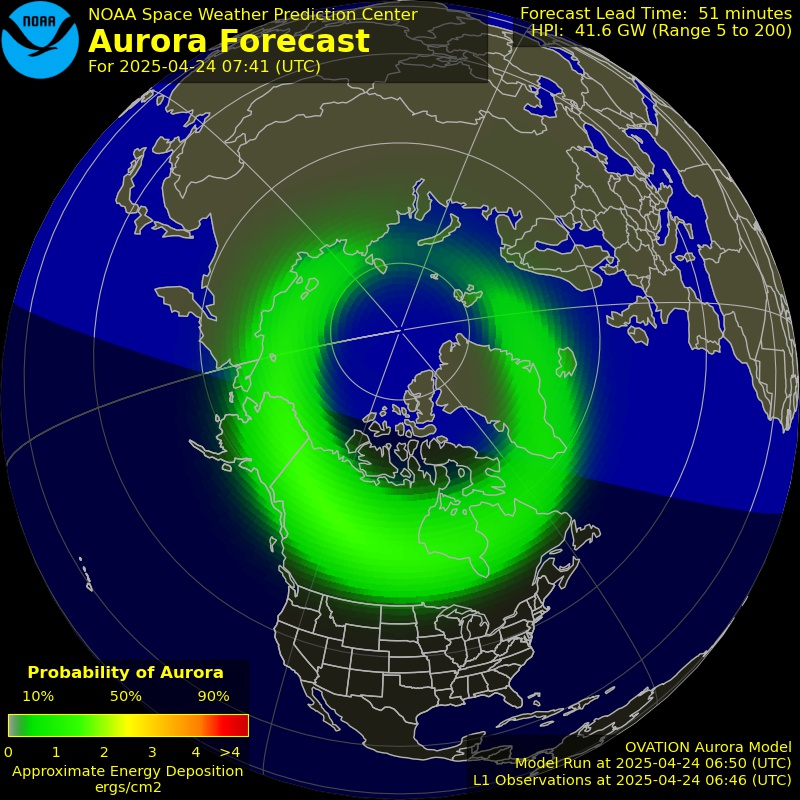
Live aurora forecast from NOAA, matched to your city's cloud cover, moon and darkness.
Gathering sky data...
Checking geomagnetic activity and local conditions…
Next 24 hours
✓ go: dark, clear and enough activity. ~ low on the horizon only. ☁ cloud blocks it. – activity too weak. ☀ daylight. Kp is the forecast activity for that slot.
Tonight's viewing odds
Space weather right now
Local conditions
Kp forecast, aurora probability and solar wind: NOAA SWPC. Cloud cover: Open-Meteo, with OpenWeatherMap as backup. Weather: OpenWeatherMap. City search: OpenStreetMap. Visibility thresholds are estimates based on geomagnetic latitude.
Solar activity monitor
Live flare class, flare chances and solar cycle context from NOAA.
Loading…
Solar flare class right now
--
Loading live X-ray data…
A flare does not cause aurora by itself. If it launched a CME toward Earth, Kp can rise within about one to three days.
Flare chances, next 24 hours
X-ray flux, last 6 hours
Loading…
Letters mark where each flare class begins. The line is the Sun's X-ray output on a log scale.
27-day aurora outlook
Loading…
Solar cycle 25
Monthly sunspot number, last 24 months. Sunspot counts describe the long-term cycle, not tonight's activity.
Source: NOAA Space Weather Prediction Center.
Northern lights tonight: the science behind the forecast
Whether you can see the northern lights tonight depends on a chain of events that starts on the Sun, about 150 million kilometres away. The aurora is not weather. It is what happens when the Sun's outflow of charged particles collides with Earth's magnetic field, and knowing how that works tells you what the numbers in the live northern lights forecast actually mean.
You can see the northern lights tonight if three things line up: enough geomagnetic activity (the Kp index) for your latitude, a dark sky with little cloud, and a clear view toward the pole. The forecast above checks all three for your city.
How the northern lights form
Step 1: The solar wind leaves the Sun
The Sun continuously sheds charged particles called the solar wind, which normally flows past Earth at around 400 km/s. Violent eruptions called coronal mass ejections (CMEs) throw out up to a billion tonnes of plasma at speeds of up to roughly 3,000 km/s. A CME aimed at Earth arrives anywhere from under a day to about three days later, which is why a big flare today can mean northern lights tonight or later this week.
Step 2: Earth's magnetic field is disturbed
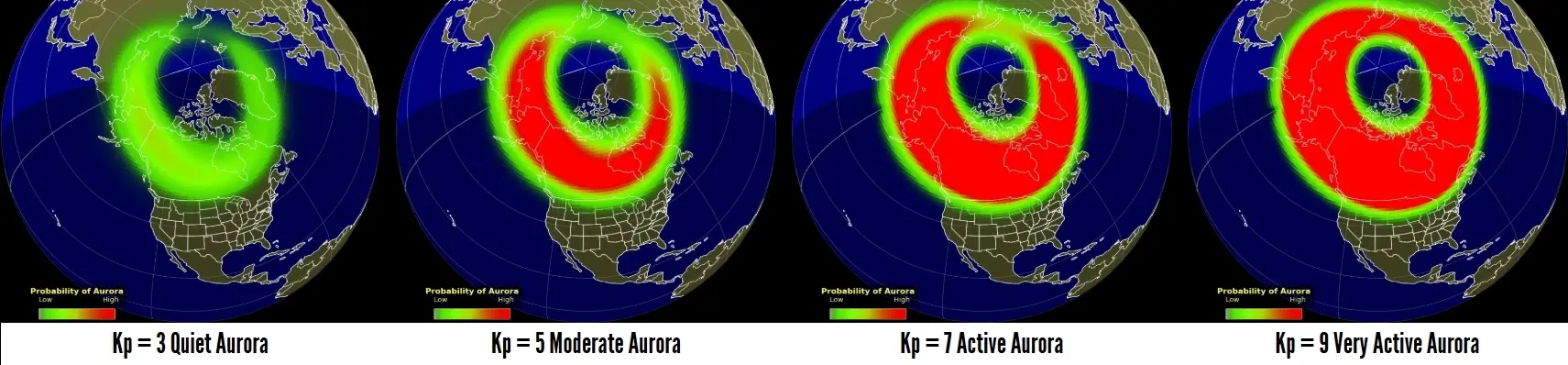
Earth's magnetosphere, the magnetic bubble around our planet, deflects most of the solar wind. A strong CME or fast stream compresses it on the day side and stretches it into a long tail on the night side. The Kp index measures how disturbed the field is on a scale from 0 (quiet) to 9 (extreme storm), and Kp 5 or higher counts as a geomagnetic storm.
The most important signal for northern lights tonight is Bz, the north-south direction of the solar wind's own magnetic field. When Bz turns southward (a negative value), it links up with Earth's field and lets energy pour in. A sustained Bz of about -5 nT or lower, together with a fast solar wind, is a strong sign that activity is about to rise.
Step 3: Magnetic reconnection sends particles toward the poles
As the magnetotail stretches, it eventually snaps back in a process called magnetic reconnection. That releases stored energy and sends electrons and protons down Earth's magnetic field lines toward the poles. This is why aurora forms in the auroral oval, a ring around each magnetic pole, and why the southern lights (aurora australis) appear at the same time as the northern lights. The stronger the storm, the farther the oval expands toward the equator, which is how a big night brings aurora to cities that rarely see it.
Step 4: Collisions in the upper atmosphere create the glow
The incoming particles strike oxygen and nitrogen atoms between roughly 80 and 650 km up and excite their electrons. When those electrons relax, they release light, the same basic physics as a neon sign. The colour depends on which gas is hit and at what altitude.
Galileo coined the term in 1619. Aurora was the Roman goddess of dawn and Boreas the Greek god of the north wind, so the name roughly means "dawn of the north."
What to check before you go out to see the northern lights tonight
- Kp against your latitude. Places inside the auroral zone, like northern Scandinavia, Alaska and northern Canada, can see aurora at low Kp. Roughly Kp 5 to 7 is needed for the northern US and central Europe. The aurora forecast shows the Kp your city needs.
- Bz and solar wind speed. A southward Bz and a speed above about 500 km/s favour a stronger display within the hour.
- Cloud cover. Cloud blocks the aurora completely, so check the hour-by-hour outlook and pick the clearest window.
- Darkness and the Moon. You need the Sun well below the horizon, and a bright Moon in the sky washes out faint displays. Get away from city lights.
- Timing. Activity often peaks within a couple of hours of local midnight. Aurora happens all year, but the long dark nights of autumn, winter and spring are best, and activity tends to run higher around the equinoxes.
- Your eyes and camera. Give your eyes about 20 minutes to adapt. A phone in night mode will show more colour than your eyes can.
Northern lights colours explained
Most northern lights tonight will look green, but the colour mix depends on the gas and the height at which the particles stop.
| Colour | Gas | Altitude | Notes |
|---|---|---|---|
| Green | Oxygen | 100–240 km | Most common. The human eye is most sensitive at this wavelength. |
| Red | Oxygen | 240–650 km | Rare. Needs intense storms and is often too faint for the naked eye. |
| Blue / purple | Nitrogen | Below 100 km | Needs highly energetic particles to reach the denser lower atmosphere. |
| Pink | Nitrogen and oxygen | About 80–100 km | Often seen on the lower fringe of a green curtain. |
Faint displays can look grey or white to the eye because our colour vision is weak in the dark. Cameras gather more light, so photos usually show stronger colour than you see in person.
Solar Cycle 25 and your chances of seeing the aurora
The Sun's activity rises and falls on a cycle of about 11 years. NASA and NOAA announced in October 2024 that the Sun had reached the solar maximum period of Solar Cycle 25, the busiest stretch for flares, CMEs and geomagnetic storms. The years just after the peak can still bring some of the strongest storms of a cycle, so a quiet-looking month does not rule out a big night. The solar activity monitor shows the live flare class and where the cycle stands now.
STEVE, dancing lights and aurora sounds
What is STEVE?
STEVE (Strong Thermal Emission Velocity Enhancement) is a narrow purple or mauve arc that stretches east to west, sometimes with green "picket fence" streaks beneath it. It is often mistaken for aurora. The arc is linked to a fast river of hot plasma flowing through the upper atmosphere at more than 20,000 km/h, so it is produced differently from the particle-driven glow of true aurora.
Why the northern lights dance and pulse
The flowing, curtain-like motion comes from shifting electric currents in the magnetosphere that steer the particle beams. Pulsating aurora, patches that blink on and off every few seconds, has a different cause. Plasma waves called chorus waves release bursts of electrons into the atmosphere in a repeating, heartbeat-like pattern.
Can you hear the northern lights?
Sámi and Inuit traditions describe the aurora crackling or clapping. Scientists were long sceptical, but in 2012 Finnish researchers recorded faint crackling sounds during geomagnetic activity. They linked them to static electricity discharging from a temperature inversion layer about 70 metres above the ground, which would explain sounds that seem to come from the lights overhead. The sounds are rare and quiet, so you need a very still night and a very active sky.
Northern lights — frequently asked questions
Where can you see the northern lights?
What time will the northern lights be visible tonight?
Can I see the northern lights tonight?
What are the northern lights and what causes them?
What is the Kp index and why does it matter?
What does solar wind Bz mean for aurora forecasting?
Aurora data on this page comes from the NOAA Space Weather Prediction Center, updated every few minutes from live satellite readings. The map above shows where the aurora oval is right now and your chance of seeing it overhead. Planning ahead? Check our 3-day northern lights forecast for expected Kp levels, or see Solar Flare Today for the latest activity from the sun.